
The clause underneath the headline percentage
1 of the 10 operators compared here publishes a welcome offer from a document: Vave, at 150% up to 1.5 BTC. The turnover that would price it is on none of the pages read, and a blank there means unread, not free.
| Coins | Withdrawal limit | Before ID check | Operator | Licence | Action |
|---|---|---|---|---|---|
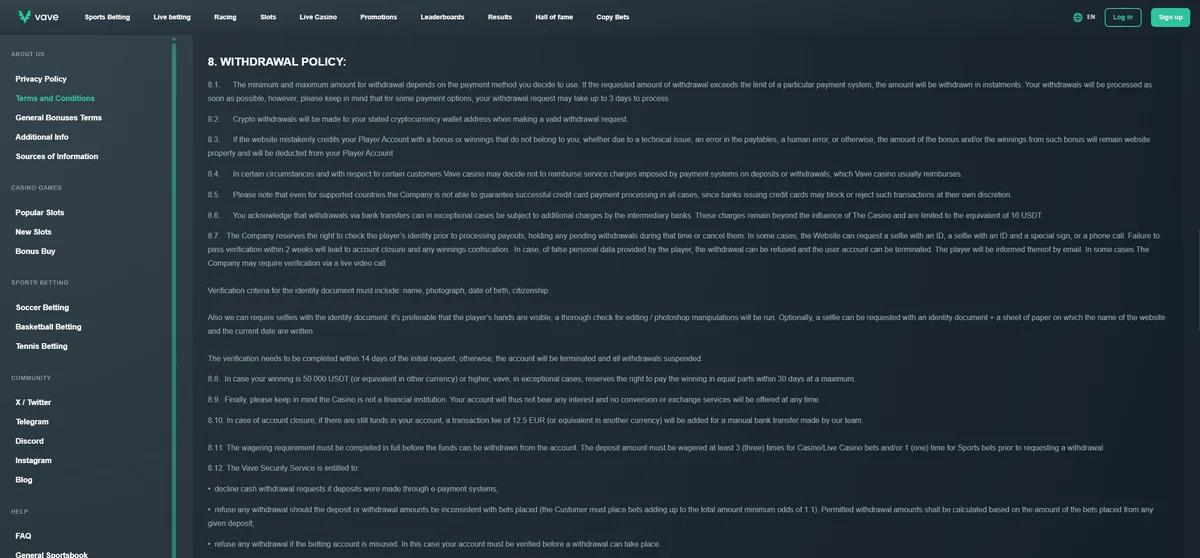
| Vave | from 50,000 USDT in instalments cl. 8.8 | case by case | Latcas B.V. | Curaçao Gaming Authority | Play |
| Rocketpot | 5,000 USD /month cl. 11.5 | US$2,500 | Danneskjold Ventures B.V. | Curacao | Play |
| Bitcasino.io | 1,000,000 USDT /week cl. 6.10 | 2,500 EUR | Moon Technologies B.V. | Curaçao Gaming Authority | Play |
| Wild Fortune | 15,000 EUR /month cl. 11.8 | case by case | Metlait SRL | Anjouan Gaming Board | Play |
| DuckDice | not published | case by case | Zentari Limitada | Anjouan Gaming Board | Play |
| Empire.io | not published | 2,000 USDT | Pixel Entertainment Limited | Anjouan Gaming Board | Play |
| Metaspins | not published | case by case | Metaspins N.V. | Curaçao Gaming Authority | Play |
| Rainbet | not published | case by case | RBGAMING N.V. | Anjouan Gaming Board | Play |
| Wild.io | 100,000 USD /week cl. 9.6 | case by case | Nonce Gaming B.V. | Curaçao Gaming Authority | Play |
| Wolf.bet | not published | case by case | Cipher Games Ltd | Government of the Autonomous Island of Anjouan, Union of Comoros | Play |
 Vave
Vave Rocketpot
 Wild Fortune
 DuckDice
 Metaspins
 Wild.io
 Wolf.bet
The percentage is marketing, not the contract
A promotion starts with a number chosen to be seen. Marketing picks the headline; the legal team writes what sits underneath it, and the second document decides whether anything can be withdrawn.
The two can contradict each other and both stay live on the same site. One operator here advertises 0% withdrawal fees on its homepage while a numbered clause in its own terms reserves the right to charge — one of three disagreements found inside operators' own material, and a reminder that the banner is not the document that gets quoted in a dispute.
Even the visible half is published by only one operator here. Vave puts a first-deposit match at 150% up to 1.5 BTC, rising over four deposits to 4 BTC and 100 free spins, a figure this desk read on its promotions page on 24 August 2026. Everything past that line stays unpublished: no wagering multiple, no stated base, no minimum odds, no deadline, and no turnover clause traceable to any document at all. Call that a gap rather than a zero — and the costlier gap of the two. None of the remaining nine operators fared any better; a document stating their welcome terms simply could not be found.
Set beside a hunt for crypto casino no deposit bonus offers, that is the honest shape of this market: only one operator in ten publishes anything at all, and even that publication is a bare percentage with no price attached.
Readers who stop at the word “free” are reading the entry rather than the exit. A credit given ahead of any deposit still carries a cap on what it can win, a turnover requirement, an expiry, and a maximum stake while it is active. Removing the deposit removes none of those. The cap, the multiple, the maximum stake and the expiry are read from the operator's own clauses for the ten crypto casinos read for Singapore.
The cap is where a percentage meets reality, so it comes first.

The cap that shrinks a large percentage
An offer written as “up to” a figure has a ceiling clause somewhere, and that clause is the real size of it.
A high match rate over a low ceiling is a small offer in a large font. Deposit past the ceiling and the excess goes unmatched entirely, which turns the headline into a statement about a narrow band of deposits rather than about the account. Vave’s package illustrates the arithmetic: 150% applies until 1.5 BTC and then stops, and the four-deposit total of 4 BTC is the outer edge of everything it can give.
Ceilings tend to sit two clicks from the banner. That distance is a design decision.
Comparing offers on the headline alone therefore compares the wrong number. A 100% match with a generous ceiling can be worth more than a 200% match with a mean one, and both stay unrankable until the turnover base is known — a base that, on this list, no promotion page states and no terms page read here supplies.
The wagering multiple and what it is calculated on
Turnover requirements are multipliers, and the clause states two things: the size of the multiple and what it is applied to.
Applied to the credit alone, the requirement is a wager on borrowed funds. Applied to the credit plus the deposit, the player’s own money is locked until the whole sum has been turned over, which can mean staking many times what anyone intended to risk. The same multiple written against two different bases produces two entirely different offers, and the difference is one preposition in one sentence.
Crypto cashiers often run higher multiples than fiat ones, and operators usually explain that by pointing to lower processing costs — a larger headline funded by a longer play-through. The percentage gets read; the multiple gets skipped.
Read from the ceiling down to the multiple, and treat the multiple as a probability statement rather than a formality: the higher it runs, the smaller the chance of reaching the end of it with a balance intact. On crypto casinos the maths is the same as anywhere else. The coin changes the rail and leaves the arithmetic alone.
Vave shows what it looks like when only one of the two documents can be produced. A promotions page carries the percentage, dated and quotable. The multiple, the base it applies to, the minimum odds and the deadline appear on that page nowhere, and nowhere else read here. A reader who takes the headline as the offer has the generous half and no way to price it.
The maximum bet clause and the expiry
While a promotional balance is live, a stake ceiling usually applies to every single round. Exceed it once and the credit and everything won with it can be voided, with intent left entirely out of it.
The figure is normally small.
That clause often lives somewhere other than the promotion page. It may sit in the general terms, or in the rules for a particular game, and a player who missed it can void an offer on the first spin while believing themselves well inside the rules. Acceptance happened at the moment of claiming, which makes the clause enforceable whether it was read or skipped.
Expiry is the second half of the same trap. The terms state how long the turnover has to be completed in, and the clock usually starts when the credit lands rather than when the player next logs in. Miss the deadline and the balance goes, winnings included.
The two clauses work against each other by design. A short deadline pushes a player toward larger stakes, the stake ceiling forbids exactly that, and the gap between them is a deliberate reduction in what the promotion is worth. Once a player reaches real money play the conditions lapse — after they have done their work.
The contribution schedule that makes table games count for nothing
Every offer carries a schedule listing game categories against the percentage of each stake that counts toward turnover. Slots typically clear it in full, table games typically clear none of it, and a live dealer round is frequently shut out completely.
Someone who spends their session on blackjack can grind through hours of play with the requirement barely moved.
That exclusion lands on a product the operator did not build. The table is streamed from a studio floor, the dealer works for the studio, and the stream and the clause wrapped around it come from two different companies.
The schedule is rarely hidden and frequently long, running to dozens of titles and percentages, and skipping it means agreeing to a condition that can void the whole exercise. Nine of these ten put their offers on a banner and leave the governing terms unreadable, so for them the schedule question cannot even be asked from a document — which is its own answer about how readable the offer is.
Reading that schedule is part of the checks run before an operator appears in the table. It is the point where marketing language stops and contract language starts, and where a headline percentage quietly becomes a slots-only proposition.
Where this leaves a Singapore player
Singapore’s regulator, the Gambling Regulatory Authority, licenses just one remote-gambling operator, and every brand compared here sits outside that licence. Terms written by an unlicensed offshore company arrive with the Singapore dispute route missing, so a disagreement about a voided promotion ends with the operator’s own complaints process.
The Act reaches the player as well, which is the part most promotion pages leave unsaid. The law page sets it out.
Anyone this leaves worried can reach the National Council on Problem Gambling’s help line. Turnover requirements reach beyond the contractual — a large multiple pushes a player toward deposits they had not planned, and reading the clause first is a form of self-defence rather than pedantry.
The ranking method awards nothing for the size of an offer. Points go to disclosure: whether the figures exist in writing, whether a clause number travels with them, and whether the document could be read live. Nine of the ten restricted-country clauses on this table were readable, and not one of the nine names Singapore; the tenth stayed closed to this reading. Any of the nine can be revised without notice, so they are still worth opening before a deposit.
The headline advertises. The clause underneath it decides, and it is usually two clicks away.