
Three addressees, and only the first one holds the balance
A stalled withdrawal has three possible recipients: the operator, the register that issued its licence, and Singapore. The first holds the money. The second answers for a number. The third has no jurisdiction over any operator on this table.
| Coins | Withdrawal limit | Before ID check | Operator | Licence | Action |
|---|---|---|---|---|---|
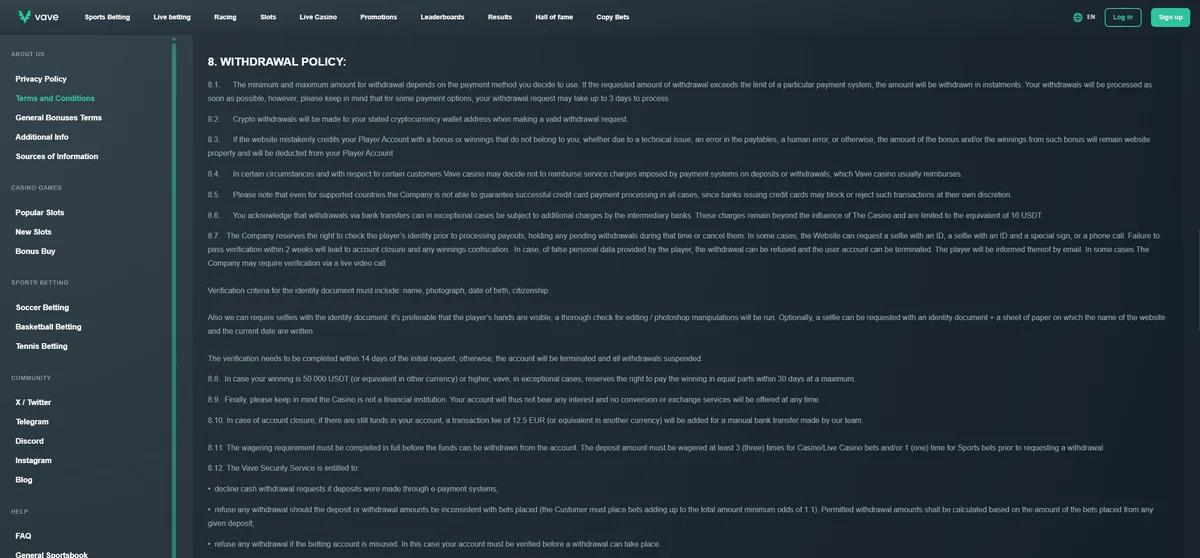
| Vave | from 50,000 USDT in instalments cl. 8.8 | case by case | Latcas B.V. | Curaçao Gaming Authority | Play |
| Rocketpot | 5,000 USD /month cl. 11.5 | US$2,500 | Danneskjold Ventures B.V. | Curacao | Play |
| Bitcasino.io | 1,000,000 USDT /week cl. 6.10 | 2,500 EUR | Moon Technologies B.V. | Curaçao Gaming Authority | Play |
| Wild Fortune | 15,000 EUR /month cl. 11.8 | case by case | Metlait SRL | Anjouan Gaming Board | Play |
| DuckDice | not published | case by case | Zentari Limitada | Anjouan Gaming Board | Play |
| Empire.io | not published | 2,000 USDT | Pixel Entertainment Limited | Anjouan Gaming Board | Play |
| Metaspins | not published | case by case | Metaspins N.V. | Curaçao Gaming Authority | Play |
| Rainbet | not published | case by case | RBGAMING N.V. | Anjouan Gaming Board | Play |
| Wild.io | 100,000 USD /week cl. 9.6 | case by case | Nonce Gaming B.V. | Curaçao Gaming Authority | Play |
| Wolf.bet | not published | case by case | Cipher Games Ltd | Government of the Autonomous Island of Anjouan, Union of Comoros | Play |
 Vave
Vave Rocketpot
 Wild Fortune
 DuckDice
 Metaspins
 Wild.io
 Wolf.bet
Three addressees, and a very uneven distribution of power
A withdrawal that has not arrived can be raised with three parties. The operator itself. The authority whose register carries its licence number. And Singapore, meaning the statutory framework the reader lives under.
Only the first of the three is holding the balance.
That sentence does most of the work on this page, because the usual mistake is to spend the first week on the second and third. A register does not release funds and it does not adjudicate an account. Singapore licenses one remote operator and it is not among the ten compared here, so nothing about this list sits inside the dispute process a licence would have carried.
Which leaves a negotiation with one counterparty, conducted entirely inside that counterparty's own terms.
The first addressee, and the column that is almost entirely empty
The operator is the only party that can move the balance, which makes its contact route the most operationally important field on the table and the one we have read least.
Of the ten operators compared here, exactly one has a support channel recorded: Vave, with live chat and email.
The other nine cells are blank. A blank means the same thing it means in every other column on this site — the field was looked for and not established — and it never means that no channel exists. But the consequence of this particular blank is different from the others. An unpublished withdrawal ceiling becomes visible on the day of a large payout. An unrecorded contact route becomes a problem on the day something has already gone wrong, which is the worst possible moment to start looking.
So the useful work happens before a deposit, not after a stall. Open the operator's own help or contact page, count the routes, and write down what you find: whether there is a live chat only, whether an email address is published, and whether either produces a reference number. Whether a published email exists at all, and whether it returns a reference number, is one of the fields recorded for the contact routes at each crypto casino Singapore.
Chat transcripts frequently vanish when the window closes. Email leaves a copy on the sender's side, and that asymmetry is worth more than it sounds.
Before it is a dispute, check whether it is a clause
A payout that has not arrived is not automatically a refusal. On this table, four operators publish a ceiling that can hold a large withdrawal back entirely lawfully under their own terms, and a fifth publishes something that looks like a delay but is not.
Four published ceilings sit on this table: 5,000 USD a month at Rocketpot (clause 11.5), 100,000 USD a week at Wild.io (clause 9.6), 15,000 EUR a month at Wild Fortune (clause 11.8), and 1,000,000 USDT a week at Bitcasino.io (clause 6.10).
Vave publishes no ceiling and instead states, at clause 8.8, that any amount over 50,000 USDT gets paid out in equal parts, spread across up to thirty days. The total does not shrink; its shape changes.
A payout held against a published ceiling is a schedule, not a refusal.
The identity clause is the other common explanation. Three operators state the figure at which documents are demanded — US$2,500 at clause 11.4, 2,500 EUR at clause 6.6, 2,000 USDT at clause 5.4 — and seven reserve the request to their own judgement, with Vave's clause 8.7 allowing it before any payout and giving fourteen days to respond. All ten clauses, and both published response deadlines, are laid out on when the identity check starts.
Matching the event against those clauses first changes the conversation. A message that quotes a clause number is a different message from one that does not, and it is answerable.
The second addressee answers for a number, not for the money
This table splits down the middle by regulator too: five sit under the Curaçao Gaming Authority, five under the Anjouan Gaming Board, and both authorities run a register anyone can query.
What the register answers is narrow and genuinely useful: whether that number is real, who the holding company is, and what status attaches to it.
What it does not answer is whether a particular account will be paid. Whether an issuing authority accepts complaints from players, and by what procedure, is not a field this desk has read, and an unread procedure does not get written up here as a step.
The register is still worth opening, for a reason that shows up precisely in disputes. Across the hundred brands behind this comparison, sixty-eight publish a licence number but there are only fifty-three distinct numbers among them, because nine numbers cover twenty-four brands between them. A registration is issued to a company; a brand is a sign over a door. Bitcasino.io and Livecasino.io both resolve to the same licence, OGL/2023/111/0069, whose holder is Moon Technologies B.V. One Anjouan number, ALSI-202508056-FI2, covers five separate brands under Novatrix SRL.
A dispute with one sign is a dispute with the company behind all of them.
Register lookups also catch the thing a footer badge never will. Five brands in the hundred display a number that resolves to a revoked entry, and three of those five sit on one number. None of them is on this table, but the check that finds them is the same check, and it is described step by step on checking an operator.

The third addressee, and the process that is not available here
Singapore licenses one operator for remote gambling, Singapore Pools, and every brand on this table is offshore of that. There is no local licence behind any of them, which means there is no local licensing condition to complain under and no regulator with authority over the account.
The Gambling Control Act 2022 gives the Gambling Regulatory Authority its powers, but since 1 January 2025 it has actually been the Singapore Police Force blocking remote gambling services that operate without a licence, blocking their advertising, and blocking the payments that reach them. Those are enforcement powers directed at services and payment flows. They are not a recovery mechanism for an individual balance, and they were never designed as one.
The Act also reaches the person placing the bet rather than only the operator. That is stated plainly by the Authority, and it is the reason this page describes the framework as written and stops there. Nothing in it should be read as advice about whether to play; the statute is set out in full on the law page.
The National Council on Problem Gambling runs a help line, and it does so whether or not a site is licensed.
What survives afterwards is what was written down
The part of this that a reader controls is the record. Four items are worth capturing as they happen: the date a request or a demand for documents arrived, the exact documents supplied, the clause number the operator cited, and the channel each message travelled through.
A reply that cites no clause is guidance, not an answer.
Deadlines deserve their own note. Where a response period is published, it constrains both sides and can be quoted back. Where none is published, the length of an acceptable wait is defined after the fact, by the party doing the waiting-out.
Currency belongs in the record too. The figures on this table are written in US dollars, euro and USDT, no clause among them states when a conversion rate is struck, and not one of the fourteen published ceilings across the hundred brands is denominated in Singapore dollars. What that does to a number the reader thought they understood is worked through on the unit question.
What this page does not offer
This desk has never opened an account with any of these ten, deposited a cent with them, or waited on a payout of any size. There is no recovery rate here, no success statistic and no account of how any operator behaved, because producing any of those would require cases this site does not have.
What it offers is a map: which of three parties can act, which clause is likely to explain a delay, and which document to open first.
The rest is the operator's own paper, and reading it before the money moves remains the only step in this sequence that is entirely under the reader's control. How each row of the table was assembled, and what the empty cells mean, is on how we rank.