
Checking an operator: registers, clauses and fees
9 of the 10 operators here print a registration number that can be typed into a register. Checking one takes about 2 minutes, and it is the only step in this procedure that runs independently of the operator’s goodwill.
| Coins | Withdrawal limit | Before ID check | Operator | Licence | Action |
|---|---|---|---|---|---|
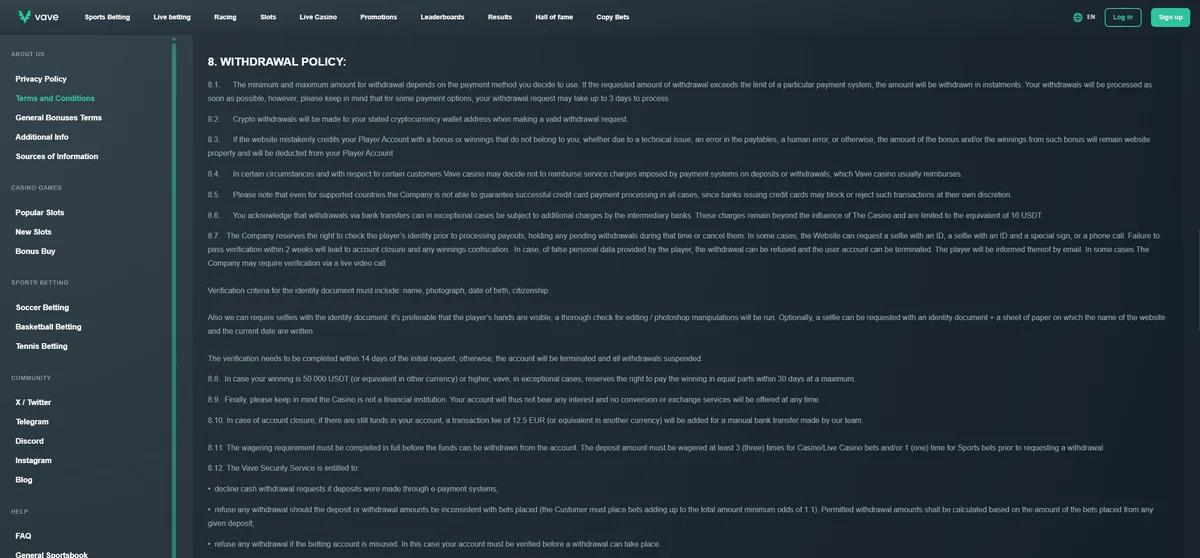
| Vave | from 50,000 USDT in instalments cl. 8.8 | case by case | Latcas B.V. | Curaçao Gaming Authority | Play |
| Rocketpot | 5,000 USD /month cl. 11.5 | US$2,500 | Danneskjold Ventures B.V. | Curacao | Play |
| Bitcasino.io | 1,000,000 USDT /week cl. 6.10 | 2,500 EUR | Moon Technologies B.V. | Curaçao Gaming Authority | Play |
| Wild Fortune | 15,000 EUR /month cl. 11.8 | case by case | Metlait SRL | Anjouan Gaming Board | Play |
| DuckDice | not published | case by case | Zentari Limitada | Anjouan Gaming Board | Play |
| Empire.io | not published | 2,000 USDT | Pixel Entertainment Limited | Anjouan Gaming Board | Play |
| Metaspins | not published | case by case | Metaspins N.V. | Curaçao Gaming Authority | Play |
| Rainbet | not published | case by case | RBGAMING N.V. | Anjouan Gaming Board | Play |
| Wild.io | 100,000 USD /week cl. 9.6 | case by case | Nonce Gaming B.V. | Curaçao Gaming Authority | Play |
| Wolf.bet | not published | case by case | Cipher Games Ltd | Government of the Autonomous Island of Anjouan, Union of Comoros | Play |
 Vave
Vave Rocketpot
 Wild Fortune
 DuckDice
 Metaspins
 Wild.io
 Wolf.bet
Why a register beats an adjective
A search for a trusted online casino singapore returns pages describing operators as reputable, safe and reliable. Every one of those words resists checking.
A public record can be.
Nine of the ten operators compared on this site print a registration number, split evenly between two regulators: five hold a Curaçao licence — often shown as the Curaçao Gaming Authority — and the other five hold an Anjouan Gaming Board licence. The tenth, Vave, prints none at all, and its cell says so. Taking a number from a footer and searching for it in the issuing authority’s own register takes a couple of minutes and settles a question that promotional copy leaves open however long it runs.
The phrase most trusted online casino singapore is an opinion with search volume behind it. A registration number, a holder company and an issuing authority are facts, and the procedure is to lift all three from the operator’s own documents before opening anything else.
Singapore’s own register is a shorter document than most readers expect. Only one operator holds a Gambling Regulatory Authority licence for remote gambling here, which puts every offshore brand outside that register by definition, and checking it mainly confirms the absence. The law page explains why the Singapore position still matters when the operator is registered elsewhere.
Registers stand apart from one another. A Curaçao claim is checked in Curaçao, an Anjouan claim in Anjouan, and a trust seal that merely points back to the operator’s own homepage confirms nothing whatsoever — a distinction that costs points in the scoring. A seal that only links to the operator's own domain is recorded as unconfirmed rather than as a licence in every crypto casino Singapore row.

What a registration number looks like
Formats vary by authority, and the format is beside the point. Some registers issue a certificate number; others issue a reference mixing letters and digits, as with the Anjouan strings carried by Wild Fortune, DuckDice, Empire.io, Rainbet and Wolf.bet, or the OGL references carried by Bitcasino.io, Metaspins and Wild.io.
What matters is whether the printed string produces a record.
A number that appears on the site but returns nothing in the register is either wrong or stale, and both are material. Look for it in the footer, the terms or an about page; a number that appears only inside a promotional graphic is weaker evidence than one repeated where a regulator or a court would look for it.
Master registrations complicate the match. Where one holder covers several brands, the register entry names the parent while the brand site shows the parent’s number, which is legitimate but adds a step — the reader has to confirm that the parent actually owns the brand. Where the terms leave the company unnamed, that chain cannot be closed, and the claim stays open.
The confiscation clause inside the terms
The most consequential sentence in a set of terms is usually the one allowing an operator to keep a balance. It hides under headings such as void bets, forfeiture, or breach of terms.
The wording varies; the effect rarely does.
A typical version says that on any breach the operator may cancel bets, close the account and retain the funds — which leaves the operator defining the breach after the event. A good clause names the breaches, sets a notice period and describes an appeal. A clause reserving the right to withhold winnings at any time, for any reason, is a blank cheque signed at sign-up.
Searching the terms for confiscate, forfeit, void and retain finds it in under a minute. Read the whole clause rather than its opening sentence, because these are commonly drafted narrow at the start and broad at the end, and the catch-all is the part that will be relied on. Bonus terms covers the promotional version of the same power, which sits in a different document from the general one.
Dormant-account fees and other running charges
Dormant-account fees apply when an account sits through a fixed period without a login, a deposit or a withdrawal, commonly six or twelve months, and they are charged either as a flat amount or as a share of the balance.
Both the period and the amount belong in the terms.
Where they are absent the fee can still arrive, because the terms will generally reserve a right to introduce charges on notice. An unpublished fee is a fee waiting for a figure, and it is the same structure as an unpublished withdrawal ceiling: the number gets set once the reader has committed. Search for dormant, inactive, maintenance fee and administrative fee, then write down the amount, the frequency and the start date and work out what two years of it does to a balance. The arithmetic asks for a published number and nothing else, which is exactly what the dangerous version withholds.
Withdrawal fees, conversion margins and closure fees deserve the same treatment. A fast payout that is fast because it is small has solved very little, and withdrawal speed separates the advertised clock from the queue behind it. Scattering charges across several pages falls well short of proof of bad faith; it does make an operator harder to check, and difficulty is itself a reason to check harder.
Applying the procedure to the comparison here
The registration check is run on this side too, which is why the licensing cell records what a register produced rather than what a footer claimed. Numbers themselves are held rather than reprinted across the guide pages, because a copied string goes stale between reviews and a stale number invites a reader to skip the search that matters.
The rest of the procedure belongs to the reader. Take the operator’s name from the table, open its own site, find the number, and search the issuing authority for it — and treat the comparison as a starting point rather than a substitute. The desk behind these figures explains the working method and how to report an error in it.
Rankings decay. A registration that resolves today can lapse tomorrow, and a position earned on disclosure says nothing about whether an operator will still be in good standing next month. A check run six months ago tells a reader nothing about the register today.
The same is true of every clause above. Terms change overnight, and only the current version is evidence.
Two rows here go further and disagree with themselves: their own clause 1.1 names one licensing authority and the number that resolves belongs to another. Which version binds you sets out the three contradictions found while reading these documents.
The restricted-country clause is the one document in this set that needs no register at all, and nine of the ten operators in this comparison put such a list where we could read it: Singapore is absent from every one of the nine. A missing confiscation clause, an unpublished dormant-account fee or an absent registration number is a gap only the operator can close.
What stays uncheckable
Some facts are outside every register. Financial reserves, complaint histories and the identity of an ultimate owner may simply be unpublished, and asking for them yields an assertion rather than a record.
Registers show current status and stop there.
The last gap is enforcement. Even a clear breach of an operator’s own terms may leave a Singapore reader with little practical recourse, because an offshore company sits beyond the everyday reach of the Authority — which makes the checks above more valuable rather than less, since the operator’s written promises are all the reader will have before any dispute. A promise that was never written down was never a promise.