
Three operators name a figure, seven name themselves
Three of the ten operators here write a number into the clause that triggers an identity check — US$2,500 at 11.4, 2,500 EUR at 6.6, 2,000 USDT at 5.4. The other seven name themselves as the trigger instead.
| Coins | Withdrawal limit | Before ID check | Operator | Licence | Action |
|---|---|---|---|---|---|
| Vave | from 50,000 USDT in instalments cl. 8.8 | case by case | Latcas B.V. | Curaçao Gaming Authority | Play |
| Rocketpot | 5,000 USD /month cl. 11.5 | US$2,500 | Danneskjold Ventures B.V. | Curacao | Play |
| Bitcasino.io | 1,000,000 USDT /week cl. 6.10 | 2,500 EUR | Moon Technologies B.V. | Curaçao Gaming Authority | Play |
| Wild Fortune | 15,000 EUR /month cl. 11.8 | case by case | Metlait SRL | Anjouan Gaming Board | Play |
| DuckDice | not published | case by case | Zentari Limitada | Anjouan Gaming Board | Play |
| Empire.io | not published | 2,000 USDT | Pixel Entertainment Limited | Anjouan Gaming Board | Play |
| Metaspins | not published | case by case | Metaspins N.V. | Curaçao Gaming Authority | Play |
| Rainbet | not published | case by case | RBGAMING N.V. | Anjouan Gaming Board | Play |
| Wild.io | 100,000 USD /week cl. 9.6 | case by case | Nonce Gaming B.V. | Curaçao Gaming Authority | Play |
| Wolf.bet | not published | case by case | Cipher Games Ltd | Government of the Autonomous Island of Anjouan, Union of Comoros | Play |
 Vave
Vave Rocketpot
 Wild Fortune
 DuckDice
 Metaspins
 Wild.io
 Wolf.bet
Three figures, three currencies, and none of them Singapore dollars
The identity clause is the shortest paragraph in a set of terms and the one most likely to decide when money arrives. Three operators on this table put a number in it.
Rocketpot states US$2,500 under clause 11.4. Bitcasino.io states 2,500 EUR under clause 6.6. Empire.io states 2,000 USDT under clause 5.4.
Those are three different units, and none of them is the Singapore dollar. No rate appears in any of the three clauses, so the figure that binds is the one in the operator's unit on the day the request is assessed, not the one the reader converted before depositing. Nothing on this site converts them, and the unit question explains why that refusal is deliberate rather than lazy.
A figure in a clause is a promise about the operator's own conduct. It is also, read the other way, a description of what happens above it.
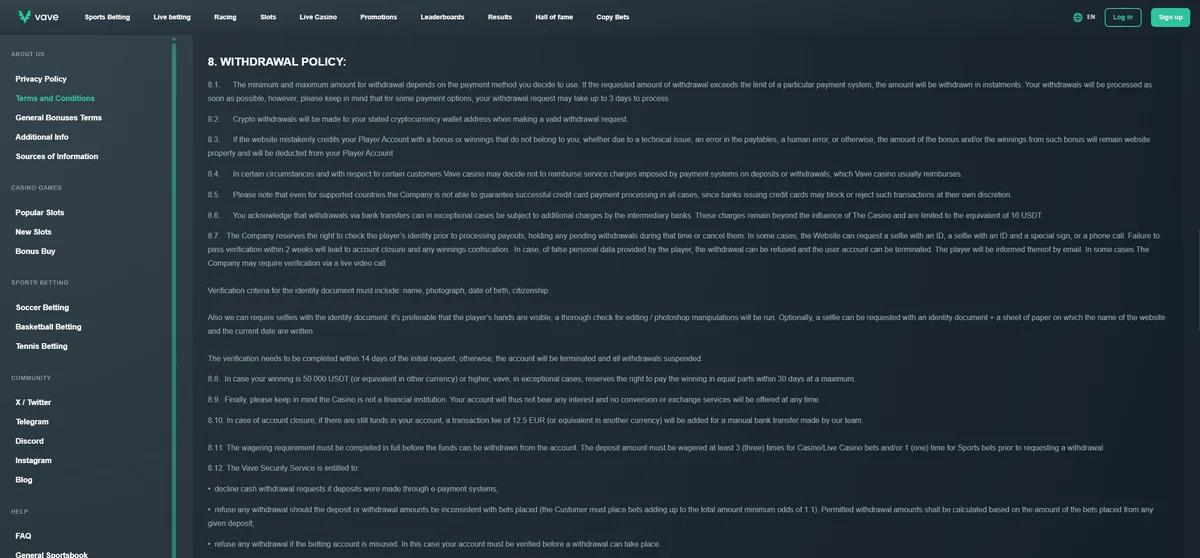
The same figure at the same clause number, in two companies' terms
Widen the reading from these ten to the hundred brands behind this comparison and the pattern gets stranger. Across all one hundred, the verification clause could be read for forty-nine. Exactly five of those forty-nine name a sum.
Three of the five name 2,500 EUR, and all three name it at clause 6.6: Bitcasino.io, Sportsbet.io and Livecasino.io.
Two of those three sit under one licence. Bitcasino.io and Livecasino.io share one Curaçao registration, OGL/2023/111/0069, issued to the holder company Moon Technologies B.V. Sportsbet.io resolves to a different number under a different holder, MBet Solutions N.V., and still carries the same figure at the same clause position. That is the signature of shared drafting rather than of three independent risk assessments. Where one number covers two brands, both rows carry the same holder in the crypto casinos checked for Singapore.
The remaining two of the five are on this table: Rocketpot at US$2,500 and Empire.io at 2,000 USDT.
So three of the network's five published thresholds are compared here, which is unusually good coverage and still only three operators in ten. The other ninety-five brands either reserve the decision or could not be read at all, and the difference between those two states is recorded rather than smoothed over on the checks page.
What the other seven wrote in place of a number
Seven operators here name themselves as the trigger. Each does it in its own words, and the words are worth reading side by side, because they are not identical.
Vave, clause 8.7: the operator may ask for documents before releasing any payout, entirely at its own discretion. Wild Fortune, clause 18.1: verification at its discretion or as required by regulators. DuckDice, Section 2: documents at any time, to establish identity, location and source of funds. Metaspins, clause 9.7: age verification is required outright, and identity verification once play reaches a threshold the clause declines to state. Rainbet, clauses 5.2 and 8.3: verification may be required before using the service or before withdrawing. Wolf.bet, Section 5: documents at any time, with service restricted until identity is sufficiently determined. Wild.io: the same discretion, plus security checks before a first withdrawal, with no clause number recorded in our reading.
Three of those seven describe a check that can arrive before a withdrawal request is ever made.
That is the part a headline about verification never covers. A discretionary clause is not a weaker version of a threshold clause; it is a different instrument. A threshold tells the reader where the line sits. A discretion tells the reader there is no line.
Why the request tends to arrive at the exit
Deposits rarely carry an identity step. The clauses that ask for documents are written into the withdrawal section, and that placement is the whole reason the phrase in the banner and the sentence in the contract can both be true at once.
An account can be opened, funded and played without a document ever being requested. Nothing in that sequence contradicts a clause that reserves the request for the payout.
This is why the search phrase crypto casino no verification describes the entrance rather than the exit. Seven of these ten reserve the right to ask, three name the figure at which they will, and not one of the ten promises never to ask. There is no operator on this table for which the phrase is a term of the contract.
The practical consequence is a matter of order. Documents requested at the point of withdrawal are documents requested when the balance is already inside the operator's system, which is a weaker position for the account holder than the same request at sign-up would have been.
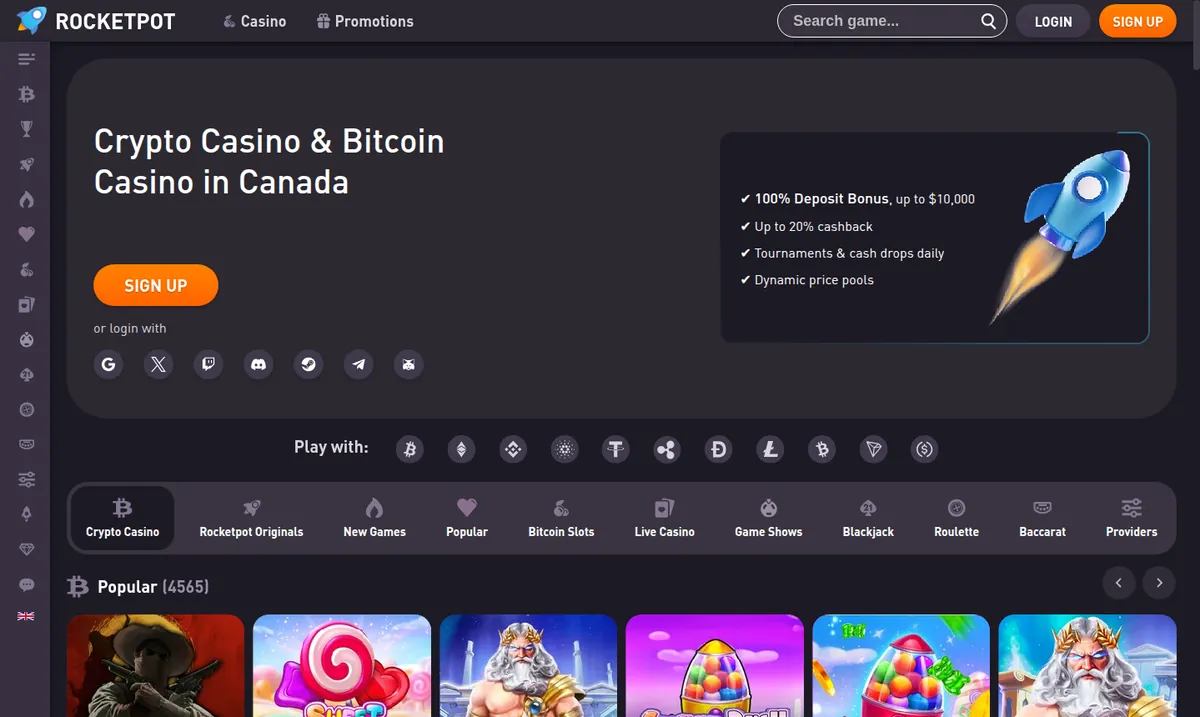
Two deadlines on this table, and eight silences
A trigger without a deadline is only half a clause. The second half says how long the account holder has to answer once documents are requested, and it is read far less often than the first.
Vave, clause 8.7, gives fourteen days.
Rocketpot, clause 11.4, gives thirty calendar days for identity and source-of-funds documents, alongside its US$2,500 figure. The same clause also mentions 0.05 BTC as an alternative expression of the threshold and a further check above US$2,000, which makes it the most heavily specified identity clause on this table by some distance.
The other eight publish no answering period we could read. Where no period is stated, the length of the wait is defined after the request rather than before it, and a reader planning around a payout has nothing to plan with.
A deadline is a constraint on both sides. That is what makes it worth finding.
What a stated figure is and is not
A published threshold is not a guarantee that no documents will be requested below it. Every one of the three clauses here says the opposite in the same breath: smaller withdrawals may also be checked, as the licence requires or as the operator sees fit.
All forty-nine verification clauses read across the hundred keep that discretion. Every single one.
So the figure is not a floor beneath which the operator has given something up. It is a ceiling above which the check becomes routine rather than exceptional, and the value of publishing it lies in what it tells the reader about the operator's own procedure rather than in any right it creates.
That distinction matters when a payout stalls, because a request that arrives above a published figure is the contract working as written, while a request that arrives with no clause behind it is a different kind of event. Which addressee holds the balance in each case is set out on what to do if a payout stalls, and the two clocks between a request and an arrival are on payout speed.
What this page cannot tell you
Nobody on this desk holds an account with any of the ten, so there is no report here of a document being requested, accepted or refused. Every sentence above comes from a clause, and the clause number is printed so the reader can open the same paragraph.
Where a clause number is missing, it is missing because our reading did not find one, and that gap is printed too.
Nothing here describes a way to avoid an identity check, and nothing on this site ever will. The subject of this page is when a check is contractually triggered and how long the reader then has, which is information for someone deciding where to deposit, not for someone trying to get around a term they have already agreed to. Where those terms sit inside Singapore's own framework is covered on the law page, and the National Council on Problem Gambling runs a help line regardless of where an operator is licensed.