
Nothing in these documents is written in Singapore dollars
Across the 100 sets of terms behind this comparison, 14 operators publish a withdrawal ceiling: 8 in euro, 3 in US dollars, 2 in USDT and 1 in euro and dollars together. None is written in Singapore dollars, and neither is any published verification threshold.
| Coins | Withdrawal limit | Before ID check | Operator | Licence | Action |
|---|---|---|---|---|---|
| Vave | from 50,000 USDT in instalments cl. 8.8 | case by case | Latcas B.V. | Curaçao Gaming Authority | Play |
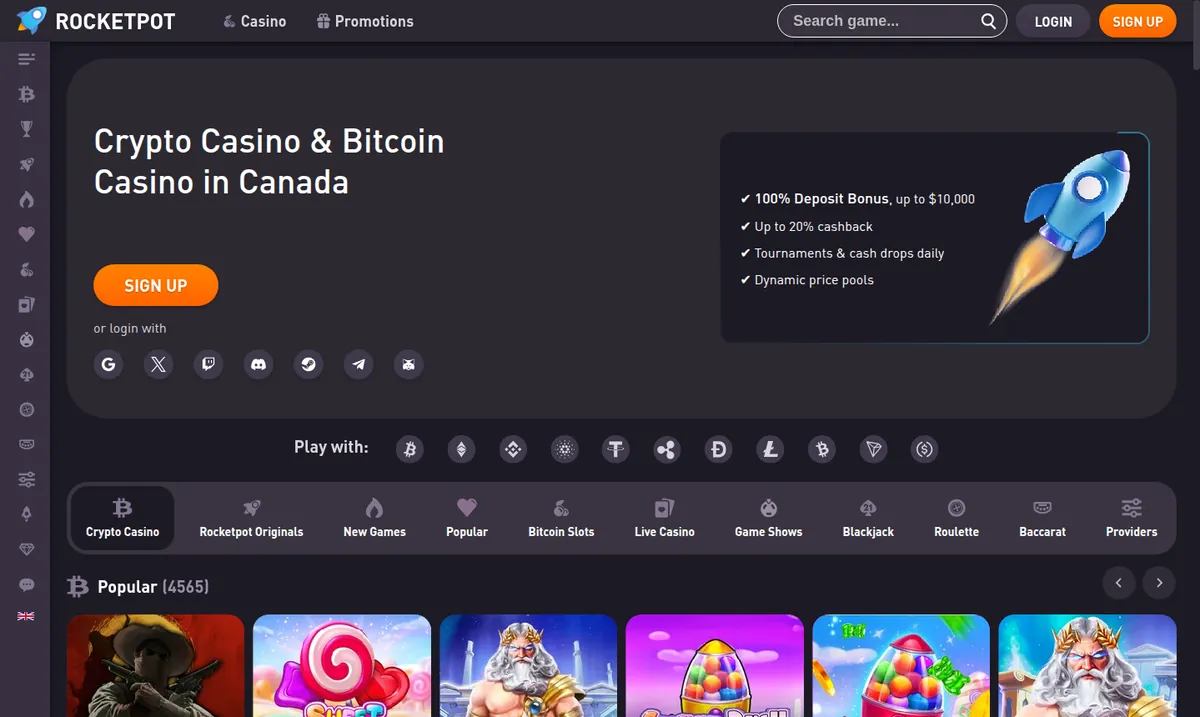
| Rocketpot | 5,000 USD /month cl. 11.5 | US$2,500 | Danneskjold Ventures B.V. | Curacao | Play |
| Bitcasino.io | 1,000,000 USDT /week cl. 6.10 | 2,500 EUR | Moon Technologies B.V. | Curaçao Gaming Authority | Play |
| Wild Fortune | 15,000 EUR /month cl. 11.8 | case by case | Metlait SRL | Anjouan Gaming Board | Play |
| DuckDice | not published | case by case | Zentari Limitada | Anjouan Gaming Board | Play |
| Empire.io | not published | 2,000 USDT | Pixel Entertainment Limited | Anjouan Gaming Board | Play |
| Metaspins | not published | case by case | Metaspins N.V. | Curaçao Gaming Authority | Play |
| Rainbet | not published | case by case | RBGAMING N.V. | Anjouan Gaming Board | Play |
| Wild.io | 100,000 USD /week cl. 9.6 | case by case | Nonce Gaming B.V. | Curaçao Gaming Authority | Play |
| Wolf.bet | not published | case by case | Cipher Games Ltd | Government of the Autonomous Island of Anjouan, Union of Comoros | Play |
 Vave
Vave Rocketpot
 Wild Fortune
 DuckDice
 Metaspins
 Wild.io
 Wolf.bet
The operator picks the unit, and the unit decides the limit
A reader in Singapore thinks in Singapore dollars. Every clause that governs their money is written in something else, and the gap between those two facts is larger than it first appears.
A ceiling is enforced in the unit it is printed in.
Wild Fortune's monthly ceiling is 15,000 EUR under clause 11.8. Whether that is a generous limit or a tight one, in Singapore dollar terms, depends on the euro rate on the day the payout is processed — a rate that appears in no clause, is set by nobody the reader can see, and moves. The number in the contract is fixed. Its meaning to the reader is not.
That is the whole subject of this page: which unit each promise is made in, who chooses it, and what a reader gives up in the two conversions nobody prices.
Four ceilings here, in three different units
Four of these ten operators publish how much may leave in a given period, and the four use three units between them.
Rocketpot sets 5,000 USD a month in clause 11.5. Wild.io sets 100,000 USD a week in clause 9.6. Wild Fortune sets 15,000 EUR a month in clause 11.8. Bitcasino.io sets 1,000,000 USDT a week in clause 6.10. Vave writes the same mechanic as a threshold rather than a ceiling: from 50,000 USDT, clause 8.8 pays in instalments.
Six rows publish no period ceiling at all, which is recorded as unpublished rather than unlimited.
Sorting those four figures into an order would require converting three of them, and this site does not convert. The reason is not fussiness. The moment 15,000 EUR becomes a Singapore dollar figure, what shows up on the page is a number nobody's terms actually contain — it rides on an exchange rate, and on whatever day that rate happened to be pulled, all while reading as more exact than the source ever was. Citing a clause beside a figure only means something because it lets a reader go to the operator's own document and land on that same figure in that same spot, and a conversion quietly breaks that link. Every ceiling on this page therefore keeps whatever currency its own clause used, among the figures printed for crypto casinos in Singapore.
The same pattern across a hundred operators
The four ceilings above are not an accident of which ten operators sit on this table. Behind this comparison is a library of 100 operators read from their own terms, and the units behave the same way at that scale.
Fourteen of the hundred publish a per-period withdrawal ceiling. Eight of those fourteen use euro, three use US dollars, two use USDT, and one gives both a euro figure and a dollar figure. None is written in Singapore dollars.
The periods are just as unevenly distributed: six of the fourteen are weekly, five monthly, two daily, and one applies to a single payout rather than to a stretch of time. A daily cap and a monthly cap of the same size are entirely different instruments, which is why withdrawal speed treats the period as the first thing to read and the amount as the second.
Published verification thresholds run the same way. Across the hundred, five operators name an amount at which identity documents are demanded, in three units: 2,500 EUR at three brands under clause 6.6, 2,500 USD at Rocketpot under clause 11.4, and 2,000 USDT at Empire.io under clause 5.4. Three of those five appear on this table.
A reader who wants a figure in their own currency will be doing the arithmetic themselves, every time, at a rate nobody in this chain has published.

What an operating currency does to an account
Wild Fortune is the clearest worked example on this table, because it states its own unit outright. Clause 11.10 names the euro as the operating currency, and once that is fixed the rest of the document follows from it.
The minimum withdrawal in clause 11.1 is 20 EUR, or the crypto equivalent at the time of the request, converted at the rate of a named third-party converter. The intermediary bank charge in clause 11.11 is capped at 16 EUR, with nothing said about what the crypto leg costs. The monthly ceiling in clause 11.8 is the euro figure above, with equivalents listed for four other currencies — none of them the Singapore dollar.
An operating currency is therefore not a formatting preference. It is the unit in which minimums are met, fees are charged and ceilings are counted, and a balance held in a coin is measured against it at a rate set at the moment of the request.
Two operators here close the question from the other side. Metaspins requires the withdrawal to use the same cryptocurrency as the deposit under clause 11.3, and the same payment method under clause 12.2. That removes the choice of unit entirely, which is more predictable and less flexible: the coin you arrived with is the coin you leave with.
Two conversions, neither of them priced
Money moving from a Singapore bank account into one of these balances changes unit twice, and comes back through both changes in reverse.
The first conversion happens at an exchange, where Singapore dollars become a coin at a rate and a fee the exchange publishes. That part is at least visible. The second happens at the operator, where the coin becomes a balance measured against the operating currency, at a rate the terms above defer to a converter or leave entirely unstated.
Neither conversion appears in the ceiling. A player who reaches a monthly cap of 15,000 EUR has reached it in euro, whatever the coin was worth on the day it was deposited, and the difference between those two valuations is nobody's stated liability.
Deposit and withdrawal fees behave the same way. Where a fee is published it can be planned for; where it is not, it can be sized after the reader has committed, which is the argument made in full on real money play. The network fee on the way in and the network fee on the way out are separate charges and are frequently disclosed differently, as crypto casinos sets out.
What to write down before funding an account
Four questions settle the unit problem for any operator, and all four are answerable from documents in a few minutes.
Which unit is the withdrawal ceiling written in, and over what period. Which unit is the verification threshold written in, if one is published at all. Which unit is the account balance actually held in — the operating currency clause, where it exists, is the fastest way to find out. And whether the terms require the withdrawal to return in the coin that was deposited.
Then convert nothing and plan in the operator's unit.
A reader who holds a target figure in Singapore dollars will meet the operator's limits in euro, dollars or USDT, and the rate that connects those two numbers is the reader's own risk from the first deposit to the last payout. That is not a flaw in any particular operator's drafting; it is what happens when a contract is written for a market it does not name.
Singapore’s own statute for this, the Gambling Control Act 2022, governs remote gambling offered to anyone here, and under it the Gambling Regulatory Authority licenses exactly one operator to provide it. Every set of terms discussed above belongs to somebody else, and the law page covers what that framework says.